


Most men do not walk into a relationship thinking they have attachment issues. They just know that something keeps going wrong.
They pull away when things get close. Or they hold on too tight and drive people away. They struggle to trust. They repeat the same patterns with different partners and wonder why nothing changes.
These are attachment issues. And they are far more common in men than most relationship advice acknowledges.
I'm Steffo Shambo, a men's tantric and relationship coach with over a decade of work helping men understand the patterns that keep them stuck in insecure relationships. This guide covers what attachment issues are, where they come from, how they show up in adult relationships, and how to begin healing them.
If you are dealing with anxious attachment specifically, the sections below cover that pattern in detail — including what to do when the alarm response fires and you feel the urge to chase reassurance.
Understanding Attachment: What It Is and Why It Matters
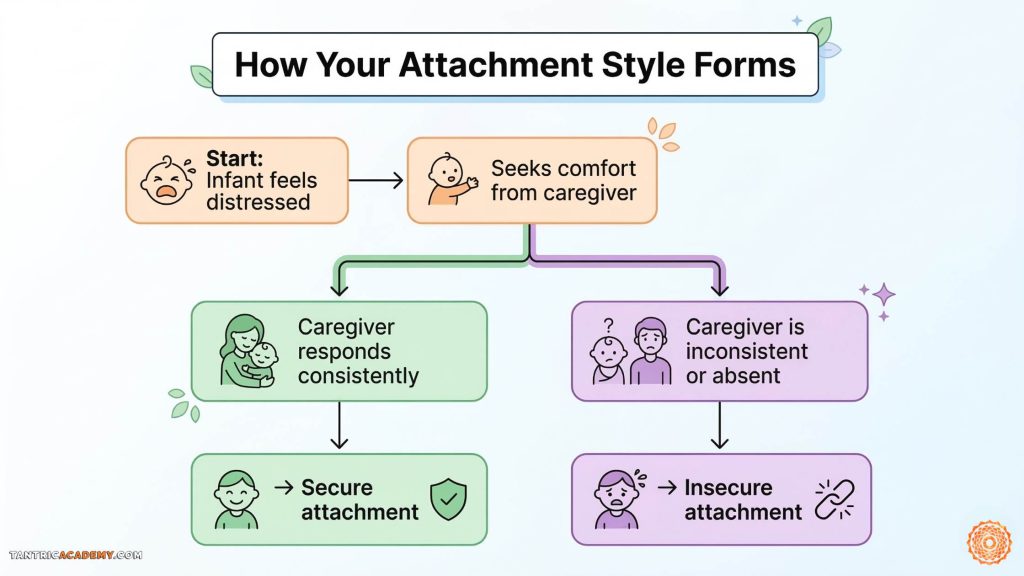
Attachment is the emotional bond that forms between a child and their primary caregiver in early life. It is one of the most researched areas in developmental psychology and one of the most overlooked in men's emotional education.
The core idea is simple. When an infant is distressed, they seek comfort from a caregiver. How that caregiver responds, consistently or inconsistently, warmly or coldly, safely or unpredictably, shapes the infant's working model of relationships. That model becomes the template the child carries into every relationship for the rest of their life.
A child who learns that their caregiver is reliable and responsive develops a secure attachment. They learn that it is safe to need other people, safe to be vulnerable, and safe to trust. They grow into adults who can form and maintain healthy relationships with relative ease.
A child who learns that their caregiver is unreliable, absent, frightening, or inconsistent develops an insecure attachment. That insecurity does not disappear at adulthood. It becomes the lens through which every adult relationship is experienced.
Understanding attachment is not about blaming parents. Most caregivers did the best they could with what they had. Understanding attachment is about recognizing that your nervous system was shaped by early experiences, and that those early experiences are still running in the background of your adult relationships right now.
FREE MASTERCLASS
Learn my proven 5-step method to build a lasting connection, rekindle your relationship, save your marriage, or meet the right partner.
Attachment Theory: The Foundation
Attachment theory was developed by British psychiatrist John Bowlby in the 1950s and 1960s. Bowlby proposed that the need to form close emotional bonds with a caregiver is a biological drive, as fundamental as hunger. When that need is met consistently, development proceeds normally. When it is not, the consequences ripple across a lifetime.
Psychologist Mary Ainsworth later identified the different attachment styles through her landmark Strange Situation experiments, observing how infants responded when separated from and reunited with their primary caregiver.
From this research emerged a framework that has since been validated across decades of studies on adult attachment, romantic relationships, parenting, and mental health outcomes. The influence of attachment styles on adult relationships is one of the most replicated findings in psychology.
Research published by the National Center for Biotechnology Information confirms that experiences in childhood have a direct impact on the type and quality of relationships that individuals develop as adults. Insecure attachments formed in childhood are consistently associated with difficulties forming healthy relationships, emotional regulation problems, and higher rates of relationship breakdown in adulthood.
The attachment bond formed in early life is not destiny. But it is a powerful starting point. Most men who struggle in relationships are not fundamentally broken. They are operating from a set of learned responses that made sense in childhood and now create problems in adult life.
Different Attachment Styles
There are four primary attachment styles. Three are forms of insecure attachment. One is secure attachment.

Secure Attachment Style
People with a secure attachment style developed a reliable, consistent relationship with their primary caregiver. They learned that it is safe to need others and safe to be needed. As adults, they can tolerate closeness without losing themselves and tolerate distance without falling apart. They communicate their needs directly, handle conflict without catastrophizing, and maintain stable relationships across time.
Mickelson, Kessler and Shaver’s nationally representative US survey of 8,098 adults, published in the Journal of Personality and Social Psychology in 1997, classified 59% as securely attached, 25% as avoidant and 11% as anxious. That means the majority of people you meet in adult relationships carry some degree of insecure attachment history.
Anxious Attachment Style
The anxious attachment style develops when a caregiver is inconsistent. Sometimes present and warm, sometimes absent or emotionally unavailable. The infant never knows what to expect, so they develop a hypervigilant monitoring system. They become attuned to every signal of possible abandonment.
In adult relationships, anxious attachment shows up as fear of abandonment, need for constant reassurance, difficulty being alone, and a tendency to interpret neutral behavior as rejection. The person with an anxious attachment style often feels too much while simultaneously struggling to communicate what they actually need.
The guide on healing anxious attachment covers this style in full detail, including five steps toward a more secure pattern.
Avoidant Attachment Style
The avoidant attachment style develops when a caregiver is consistently emotionally unavailable, dismissive of the child's emotional needs, or actively discouraging of closeness. The child learns to suppress their attachment needs entirely because expressing them produces no response or a negative one.
There are two main forms of avoidant attachment. The dismissive avoidant style involves a strong preference for independence, discomfort with closeness, and a tendency to downplay the importance of relationships. The fearful avoidant attachment style combines a desire for closeness with a fear of it, producing approach-avoidance cycles that leave both partners confused.
The dismissive avoidant attachment style guide and the guide on avoidance behavior in relationships cover these patterns in detail.
Disorganized Attachment Style
The disorganized attachment style is the most severe form of insecure attachment. It develops when the caregiver is simultaneously the source of comfort and the source of fear, most commonly in situations involving childhood trauma, abuse, or severe neglect. The child has no coherent strategy for managing their attachment needs because the person they need to seek comfort from is the person causing them harm.
Adults with a disorganized attachment style often struggle most in intimate relationships. This is also the pattern most likely to need professional support rather than self-directed work, particularly where childhood trauma is involved.
Causes of Attachment Issues
Attachment issues develop primarily in early childhood, though significant experiences in adult life can also reinforce insecure patterns. Understanding the causes is the first step toward changing them.
Inconsistent or Unavailable Caregiving
The most common cause of insecure attachment is a primary caregiver who was inconsistent in meeting the child's emotional needs. This does not require abuse or neglect in the dramatic sense. A caregiver who was emotionally present sometimes and absent other times, due to depression, work stress, their own unresolved attachment issues, or simply not understanding what the child needed, can produce insecure attachment patterns in the child.
For many men, the cultural norm of emotional distance in fathers means that the attachment bond with the most gender-relevant caregiver was already compromised before they were old enough to understand why.
Childhood Trauma
Childhood trauma is a significant cause of attachment issues, particularly the disorganized attachment style. Physical or emotional abuse, neglect, witnessing domestic violence, the sudden loss of a caregiver, or growing up in foster care all disrupt the development of a healthy attachment bond.
Children in foster care are particularly vulnerable because the repeated transitions between caregivers prevent any single stable attachment from forming. Research on children with attachment disorders shows consistently elevated rates of social and emotional difficulties in adulthood.
Reactive Attachment Disorder and DSED
In clinical contexts, the most severe forms of attachment disruption are classified as reactive attachment disorder (RAD) and disinhibited social engagement disorder (DSED). These are two distinct attachment disorders recognized in the DSM-5.
Reactive attachment disorder is characterized by a child who rarely seeks comfort from caregivers when distressed and shows minimal social and emotional responsiveness. Children with RAD have often experienced severe neglect or multiple caregiver changes in infancy.
Disinhibited social engagement disorder involves the opposite pattern. Children with DSED show indiscriminate friendliness toward unfamiliar adults, approaching and interacting with strangers in ways that violate typical social boundaries. Children with DSED, like children with RAD, have typically experienced early caregiving disruption, often in institutional settings.
Both conditions require clinical assessment and treatment. If you suspect a child in your care may have either of these conditions, consulting a mental health professional is essential.
Signs of Attachment Issues in Men

Attachment issues in adults rarely announce themselves clearly. They show up as behavioral patterns that feel normal to the person experiencing them because they have operated this way for their entire life.
Here are the most common signs of attachment issues in men:
- Difficulty trusting partners even when there is no evidence of untrustworthiness
- A pattern of relationships ending in the same way regardless of who the partner is
- Pulling away or shutting down when a relationship becomes more intimate
- Fear of abandonment that leads to clingy or controlling behavior
- Emotional dependency on a partner for a sense of self-worth or safety
- Difficulty being alone without significant distress
- Avoiding commitment or refusing to define relationships
- Feeling emotionally needy but being unable to ask for what you actually need
- Attracting or being attracted to partners who recreate familiar childhood dynamics
- Significant difficulty maintaining relationships over time
If you recognize the pattern of emotional neediness specifically, the guide on being emotionally needy in relationships covers the signs and what drives this pattern in men.
One of the most reliable signs of attachment issues is not any single behavior but the repetition of patterns. If the same dynamic keeps appearing with different people, the common factor is not the other person. It is also why missing an ex can persist long past the point where the relationship itself made sense. It is the attachment blueprint you are bringing to every relationship.
Attachment Issues in Adults: How They Affect Relationships
Attachment issues do not stay in the past. They actively shape adult relationships in real time. The nervous system that learned to expect inconsistency, rejection, or fear from caregivers does not distinguish between a parent from thirty years ago and a partner today. It responds to perceived threat with the same strategies it developed in childhood.
For men with anxious attachment, adult relationships are often marked by hypervigilance for signs of rejection, difficulty regulating emotion when conflict arises, and a tendency to escalate rather than withdraw. They struggle to form healthy relationships because their need for reassurance often pushes partners away, confirming the abandonment they feared.
For men with avoidant attachment, adult relationships are often marked by emotional distance, discomfort with vulnerability, and a tendency to prioritize independence over connection. They may genuinely want intimacy but find that getting close triggers a withdrawal response they do not fully understand or control.
The anxious avoidant trap is one of the most common and painful relationship dynamics. An anxiously attached person pairs with an avoidantly attached person. The more the anxious partner pursues, the more the avoidant partner withdraws. The more the avoidant withdraws, the more the anxious partner pursues. Both are operating from their attachment programming, and neither can see it clearly from inside the pattern.

The guide on men with commitment issues covers one of the most common adult manifestations of insecure attachment in men.
Improving relationship skills is possible regardless of your attachment history, but it requires understanding what is driving the patterns before you can change them.
The Male Socialization Layer
Attachment issues in men carry an additional dimension that most clinical resources do not address. Male socialization actively reinforces insecure attachment patterns, particularly avoidant ones.
Boys are consistently discouraged from seeking comfort, expressing emotional needs, or showing vulnerability. The cultural message that men should be self-sufficient, emotionally contained, and not need anyone is precisely the dismissive avoidant attachment strategy applied at a cultural level. Many men who would be classified as having avoidant attachment issues are simply men who were successfully socialized in the way their culture intended.
This makes attachment issues particularly difficult for men to recognize and address. The behaviors that stem from insecure attachment often feel like strength. Independence feels like self-sufficiency. Emotional shutdown feels like composure. Avoidance of intimacy feels like not being needy.
Understanding that these patterns have roots in early attachment rather than being fixed character traits is one of the most important reframes available to men who want to build healthier relationships.
Mental Health and Attachment Issues
Attachment issues are not a mental health disorder in themselves, but insecure attachment is consistently associated with higher rates of anxiety, depression, and relationship-related mental health difficulties.
Adults with insecure attachment styles show elevated stress responses in relationship contexts, greater difficulty with emotional regulation, and a higher likelihood of developing mental health issues in response to relationship stress. The association between attachment insecurity and mental health is one of the most replicated findings in adult attachment research.
If attachment issues are significantly affecting your mental health or your ability to maintain relationships, working with a mental health professional is a valuable step. Therapy approaches including cognitive behavioral therapy, emotionally focused therapy, and somatic therapies have all shown effectiveness in working with insecure attachment patterns.
For men who want to work on attachment patterns in a context that integrates the body and masculine development specifically, coaching that combines somatic awareness with relational work can be particularly effective. Most therapeutic approaches to attachment focus on cognition. Somatic and tantric approaches work directly with the nervous system patterns where attachment is actually stored.
How to Heal Attachment Issues
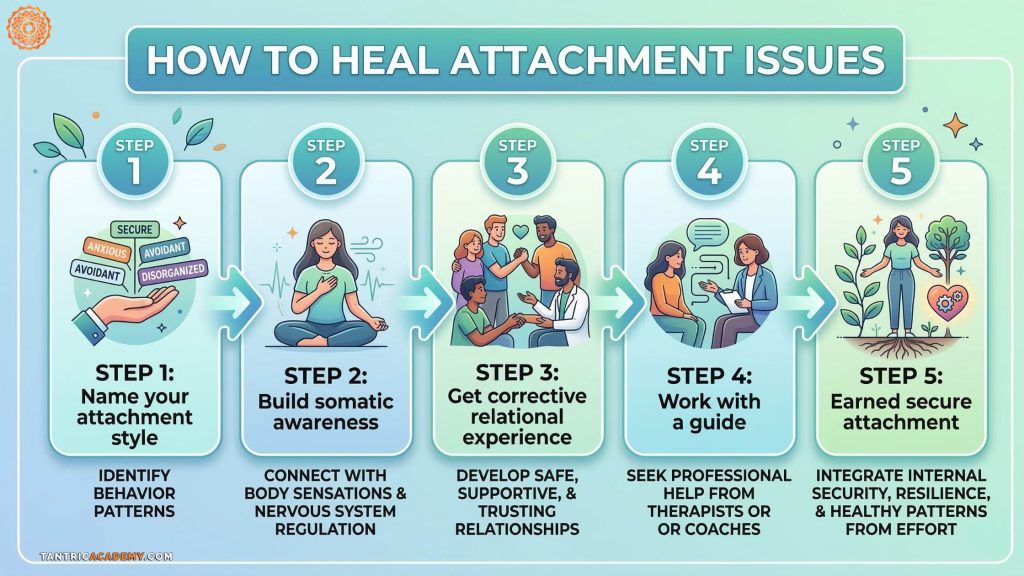
Healing attachment issues is not about undoing your childhood. It is about developing what researchers call earned secure attachment, a secure attachment style developed through intentional experience rather than inherited from early caregiving.
People with earned secure attachment have typically done one or more of the following: meaningful long-term therapy, a deeply secure relationship with a partner or close friend who provided consistent emotional safety, significant personal development work, or structured coaching or mentorship. The nervous system can learn new responses to intimacy at any age. It requires consistent new experience, not just insight.
1. Name Your Attachment Style
The first step is identifying which attachment style is most dominant for you. Most men recognize elements of more than one style. This is normal. The goal is not a perfect diagnosis but a working map of your patterns. Once you can name what you tend to do under relational stress, you can begin to notice it in real time rather than only in retrospect.
2. Develop Somatic Awareness
Attachment patterns live in the body before they live in behavior. The anxious attachment response is a felt sense of alarm in the chest and gut. The avoidant response is a felt sense of constriction and withdrawal. Learning to notice these bodily signals before they drive behavior is one of the most direct routes to changing attachment responses.
Practices like breathwork, meditation, and body-based awareness all develop this capacity. They are not supplementary to healing attachment issues. For men specifically, they are often the most effective primary approach.
The work of developing masculine energy and the practices covered in shadow work both address the deeper roots of insecure attachment patterns in men.
3. Seek Corrective Relational Experience
Attachment patterns change through relationship, not just reflection. A corrective relational experience is any ongoing relationship where your nervous system learns, through repeated experience, that closeness is safe. This can be a therapeutic relationship, a friendship, a coaching relationship, or a romantic partnership where both people are committed to conscious relating.
The key is consistency over time. A single good experience does not rewire the nervous system. Repeated experiences of safety, attunement, and repair after rupture do.
4. Build Narcissist-Codependent Pattern Awareness
Many men with attachment issues find themselves caught in narcissist codependent relationship dynamics without recognizing the pattern. Understanding how insecure attachment creates vulnerability to these dynamics is essential to breaking out of them.
5. Work With a Guide
Attachment issues are among the most difficult patterns to shift through solo effort alone. The same relational nervous system that developed in relationship needs relationship to heal. Working with a coach, therapist, or mentor who understands attachment and can provide consistent, attuned engagement accelerates the process significantly.
Start Healing Your Attachment Patterns
Attachment issues are not a life sentence. They are learned patterns, and learned patterns can change. The men who make the most progress are not the ones who try hardest in isolation. They are the ones who understand their patterns clearly and then put themselves consistently in relationships and environments where new learning is possible.
You already took the first step by reading this far. The next step is deciding whether you want to address this on your own or with structured support.
If you want to work directly on your attachment patterns in a structured mentorship context that combines somatic practice, relationship skills, and masculine development, The Tantric Man Experience is designed for exactly this work.
FREE MASTERCLASS
Learn my proven 5-step method to build a lasting connection, rekindle your relationship, save your marriage, or meet the right partner.
Frequently Asked Questions About Attachment Issues In Men
What are attachment issues?
Attachment issues are difficulties forming or maintaining healthy emotional bonds in relationships. They develop when the attachment bond between a child and their primary caregiver is disrupted through inconsistency, emotional unavailability, trauma, or neglect. In adults, attachment issues typically show up as recurring patterns of anxiety, avoidance, or disorganization in intimate relationships.
What are the signs of attachment issues in adults?
Common signs include fear of abandonment, difficulty trusting partners, emotional shutdown when relationships become intimate, compulsive need for reassurance, difficulty being alone, repeated relationship patterns that end the same way, and inability to maintain relationships over time. Many adults with attachment issues are not aware that their patterns have roots in early childhood experience.
Can adults heal attachment issues?
Yes. Adults can develop earned secure attachment through consistent corrective relational experience, whether in therapy, coaching, or a conscious long-term relationship. Healing attachment issues does not require revisiting every painful memory from childhood. It requires building new relational experiences where the nervous system learns that closeness is safe. Somatic practices that work directly with the body accelerate this process for many men.
What is the difference between attachment issues and attachment disorders?
Attachment issues is a general term for insecure attachment patterns that affect adult relationships. Attachment disorders are clinical diagnoses given to children, specifically reactive attachment disorder and disinhibited social engagement disorder, that develop from severe early caregiving disruption. Most adults dealing with relationship difficulties have attachment issues rooted in insecure attachment styles rather than clinically diagnosed attachment disorders.
Which attachment style is most common in men?
Avoidant attachment, particularly the dismissive avoidant style, is disproportionately common in men. Male socialization actively reinforces avoidant attachment behaviors: emotional self-sufficiency, suppression of attachment needs, and discomfort with vulnerability. This means many men with significant avoidant attachment patterns do not recognize them as attachment issues because the behaviors feel culturally normal rather than problematic.
How does attachment theory apply to adult relationships?
Attachment theory explains adult relationships in terms of the working models of self and others that were developed in childhood. A person with secure attachment expects relationships to be safe and approaches intimacy with openness. A person with insecure attachment approaches intimacy through their specific insecurity, whether anxious hypervigilance, avoidant self-protection, or disorganized confusion. These working models operate largely below conscious awareness and drive behavior in relationship stress situations.