
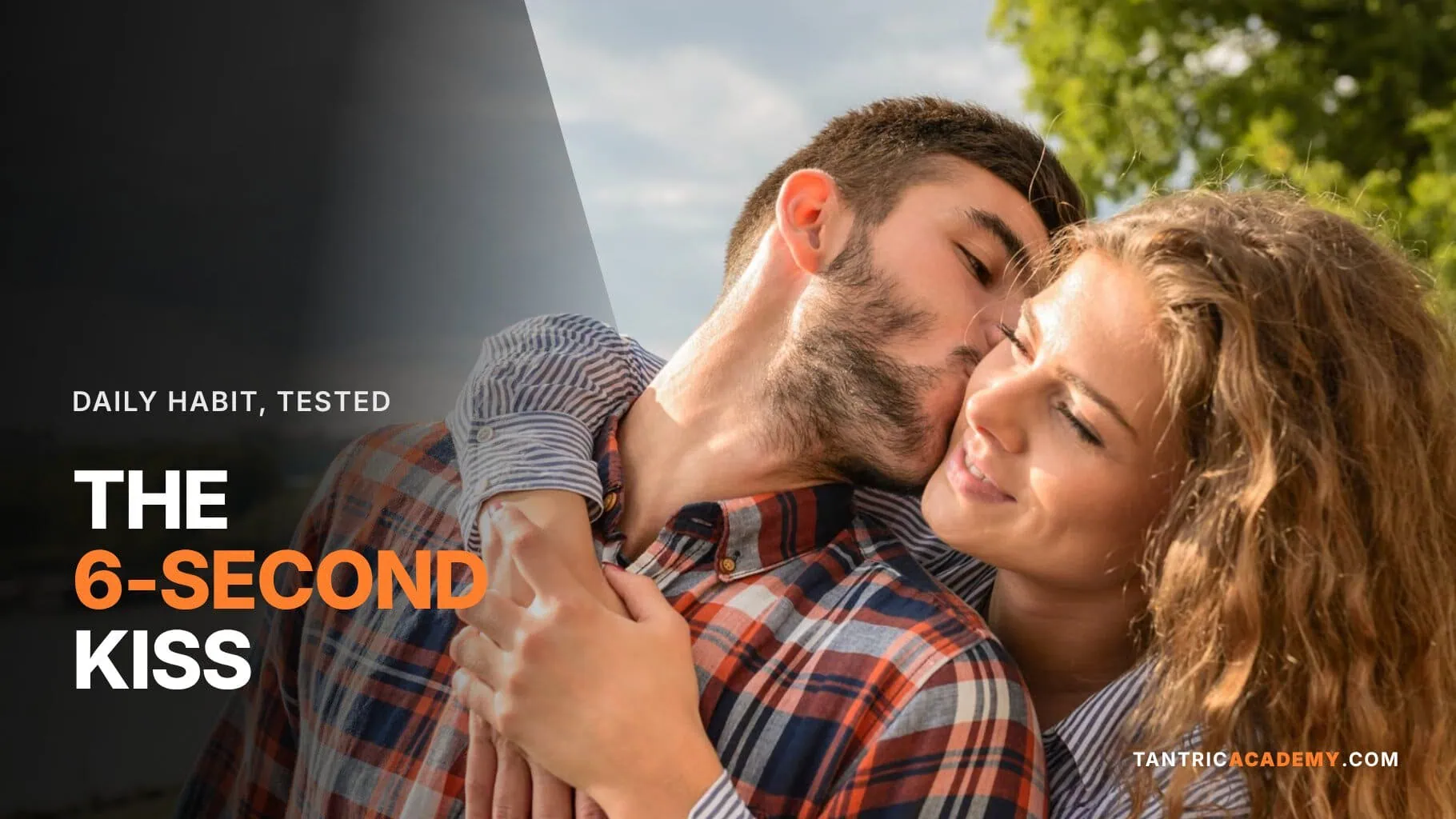
The 6-second kiss is a small daily habit. Once or twice a day, usually when one of you leaves the house or comes home, you kiss the woman you love for at least 6 seconds and you keep your attention on her for the whole kiss instead of rushing off to the next thing. The idea comes from the psychologist Dr. John Gottman, and it's one of the first things I give men who tell me the sex has stopped.
Key Takeaways
- The 6-second kiss comes from Dr. John Gottman's work with married couples. The 6 seconds is his rule of thumb, and no study has compared it with a 3-second or a 10-second kiss.
- In a 6-week trial with 52 married and cohabiting adults, the people told to kiss their partner more often reported less stress and more satisfaction with their relationship than the group that got no instructions, and their cholesterol went down too.
- The oxytocin claim you see everywhere is shakier. In a small study of 15 couples, oxytocin went up in the men after kissing and went down in the women.
- Do it when you leave and when you come home, and keep it separate from asking for sex.
What I told GQ
In October 2025 GQ South Africa ran a piece on the 6-second kiss and asked me why it works. The line from that interview I stand behind most is that "several seconds of connected kissing is better than any distracted intimacy." You can read the full article on GQ South Africa, and the rest of my press is on my about page.
If you're like most of the guys I work with, you kiss the woman you love every day already. But how long does that kiss last? For most men it's a peck on the way out the door with the car keys in one hand, and their head is already at work before their lips have left hers.
How long is 6 seconds, really?
Tap the button and watch the bar. Most men are surprised how long it takes.
That was 6 seconds. Tap the button twice to run it again.
I also talked to GQ about hormones, oxytocin and cortisol especially. That's the part I'd say differently today, because the studies behind it are much smaller than the internet makes them sound. I've put what they actually found further down this page.
Where the 6 seconds comes from
Dr. John Gottman spent decades studying married couples at the University of Washington, and he paid close attention to how couples say goodbye in the morning and hello in the evening. Those two moments happen every single day, and most couples spend them talking about groceries and school pickups.
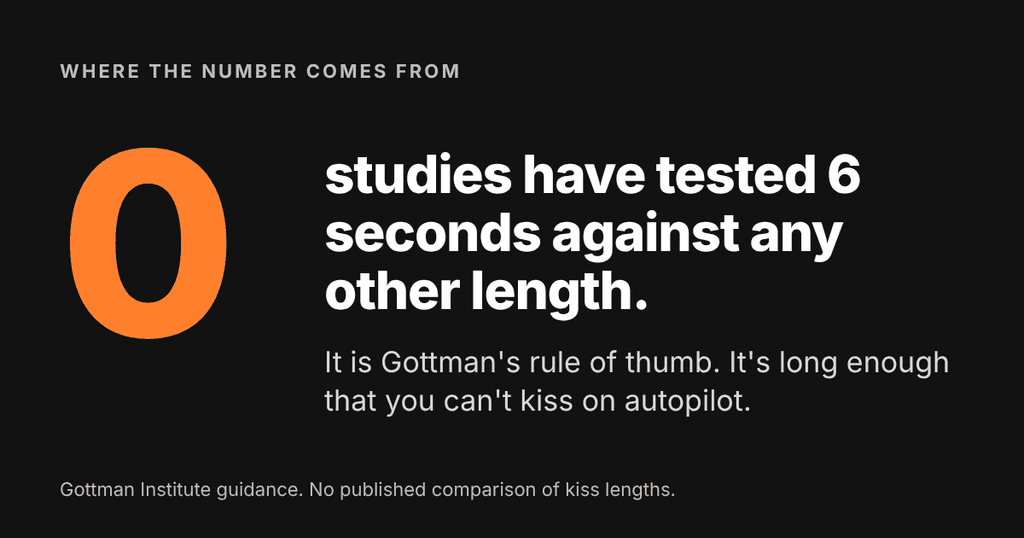
The Gottman Institute's reasoning is simple. A 6-second kiss is too long to do on autopilot, so for those 6 seconds your attention is on her and not on your to-do list.
The 6 seconds itself is advice. Gottman hasn't published a study comparing a 6-second kiss with a shorter one, and nobody else has either. So if a website tells you oxytocin switches on at exactly 6 seconds, nobody has measured that.
What the research actually shows
The best study on kissing and stress is from 2009. Kory Floyd and his colleagues took 52 healthy adults who were married or living with a partner, and they split them into two groups for 6 weeks. One group was told to kiss their partner more often, and the other group got no instructions at all. After 6 weeks, the kissing group reported less stress and more satisfaction with their relationship, and their total cholesterol had gone down. The study was published in the Western Journal of Communication.
It's a small study, and it tested kissing more often rather than kissing for longer. But it's a real trial with a control group, which is more than most advice about relationships can point to.

The hormone research is messier. In 2007 Wendy Hill and Carey Wilson at Lafayette College measured hormones in 15 college couples before and after they kissed. Cortisol, the stress hormone, went down in both the men and the women. Oxytocin went up in the men but it went down in the women. Hill and Wilson presented the results at a neuroscience conference and Scientific American covered it, but it was 15 couples in a lab, so treat it as a hint and nothing more.
The claims about the 6-second kiss, checked
The dots show how much weight I'd give each claim, from none to three.
So when I told GQ that kissing is full of oxytocin, I was giving the popular version. The evidence supports something smaller: couples who kiss more often feel less stressed and happier with each other. For a habit that takes 12 seconds a day, I'll take that.
How to do the 6-second kiss

Pick two moments that already happen every day, like when one of you leaves in the morning and when you see each other again in the evening. Tying the kiss to something you already do is what makes it stick, because you don't have to remember it.
Your 12 seconds a day
One kiss when you say goodbye and one when you see her again, set against the 16 hours you're awake.
That's 12 seconds out of 57,600, or about 0.02% of your waking day. The orange marks are drawn far wider than 6 seconds, or you wouldn't see them at all.
Stop what you're doing first. Put the phone and the bag down and turn your whole body toward her. A kiss while you're still walking out the door doesn't count, however long it lasts.
Put a hand on her, on her lower back or the side of her face, wherever feels natural between the two of you.
Then slow down and take a breath. The first few times, 6 seconds will feel longer than you expect, and most men end up counting in their head. Try paying attention to her lips instead. Felix, who went through my 9-week program, described kissing like this:
"When you kiss somebody, you enjoy the lips. You just feel it everywhere. [...] Because you're not focused on 'oh, come on, let's go.'"
Felix, married, father of young kids
Then let the kiss end. Don't turn it into a request for sex, and don't ask her how it was. If every kiss comes with an agenda, it stops being something the two of you can simply enjoy, and it becomes one more thing she has to say yes or no to.
The sensate focus exercise takes the same approach to every kind of touch. For the first stages sex is off the table, so neither of you has to wonder whether a touch is leading somewhere.
The 6-second kiss in four steps
FREE MASTERCLASS
Learn my proven 5-step method to build a lasting connection, rekindle your relationship, save your marriage, or meet the right partner.
What if she pulls away after 2 seconds?

"She pulls away after 2 seconds" is the thing I hear most about this habit, and it usually comes from men who have been turned down for sex many times. If every hug for the last year has ended with you asking for more, then a long kiss is going to look like the start of that same conversation.
Austin S. was in a marriage like that when he started working with me. In his words: "we were in a position where it got so bad my wife asked me not to touch her unless I asked. The trust issues were that bad."
So for the first week or two, let the kiss be as short as she wants it to be, and keep your attention on her for however long it lasts. And tell her what you're doing, in plain words: "I want to kiss you properly when I leave and when I get home. That's all it is."
If she's saying no to sex as well as to the kiss, I go through the most common reasons in my guide to why your girlfriend won't have sex with you.
Austin didn't start with a kiss. He started with himself, by being less needy and by no longer blaming his wife and telling her she wasn't doing enough. About 3 weeks into the program, she was the one who asked him for sex. You can watch Austin tell the whole story himself.
I made a video for my Magnetic Husband channel for men whose wife has gone distant. The part on why attraction grows in small moments starts at 6:34, and the part on what to do when she pulls away starts at 9:29.
What a kiss won’t fix
A 6-second kiss is a small habit, and it works best on a relationship where life got busy with work and kids and the two of you stopped touching each other much. If the sex has stopped completely, the kiss is still a good place to start, but it won't be enough by itself. I wrote about what else it takes to get sex back in my guide to sexless marriage.
The kiss is one part of physical intimacy, and I cover the rest of it, from hugging to sex, in my guide to physical intimacy.
Frequently asked questions
Who came up with the 6-second kiss?
Dr. John Gottman, the psychologist known for his research on married couples. The Gottman Institute recommends it as a daily habit for couples, especially when you leave each other and when you reunite.
Does it have to be exactly 6 seconds?
No. The number is there to make the kiss long enough that you can't do it while thinking about something else. If 8 seconds feels right between the two of you, do 8.
Is the 6-second kiss backed by science?
Partly. A 2009 trial found that couples told to kiss more often reported less stress and more satisfaction with their relationship after 6 weeks. Nobody has tested the 6 seconds specifically, and the claims about oxytocin come from very small studies with mixed results.
Try it tonight. When you get home, find her before you do anything else and kiss her for 6 seconds.
FREE MASTERCLASS
Learn my proven 5-step method to build a lasting connection, rekindle your relationship, save your marriage, or meet the right partner.